Solarspin Design’s First Book
About the book:
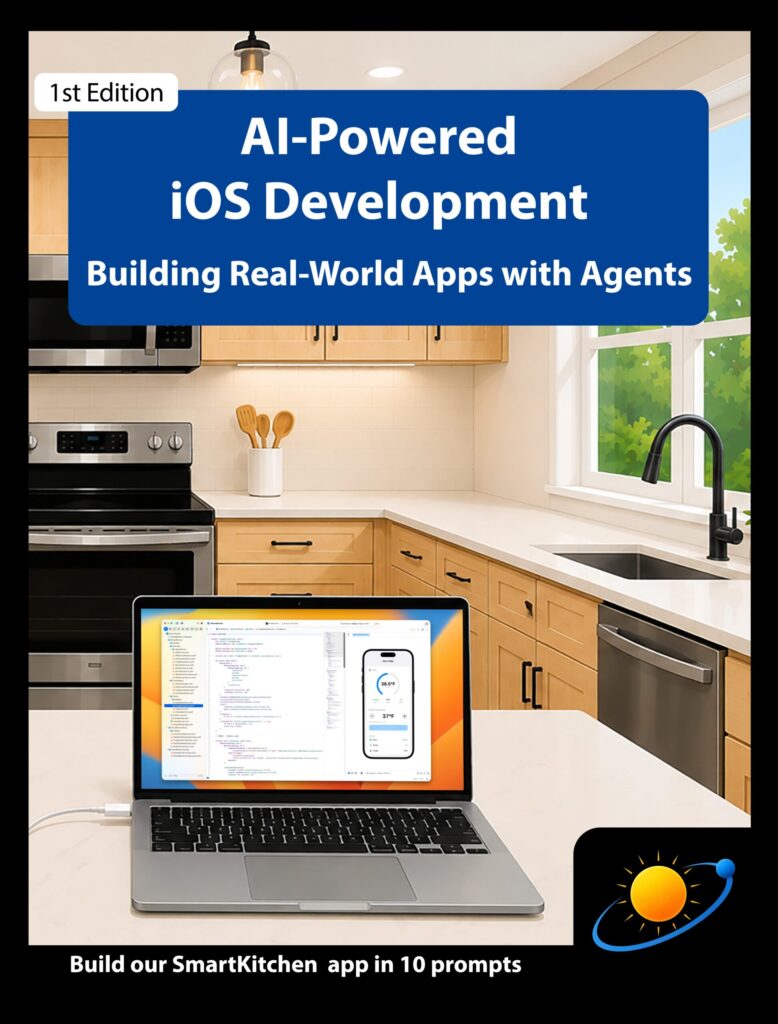
We’ve spent the past year pushing AI to its limits to see if it could build real world iOS apps. This book captures what we learned – the breakthroughs, the failures, and the patterns that work in production. It’s a step-by-step walkthrough with working code so you can skip the trial and error.
Who Should Read it:
– Developers curious if AI can improve their workflow
– Teams evaluating AI for production app development
– Educators teaching modern iOS app development
– Companies looking for common AI pitfalls and security vulnerabilities
What you’ll Learn:
By the end you will have a clear picture of what AI can and can’t do when it comes to software development. You will know when to reach for it, and when to put it down. You will know how to guide it toward code that ships. Most importantly you will be able to learn how to build apps better and faster without sacrificing quality or control.
Excerpt from Chapter 3
The AI Development Loop
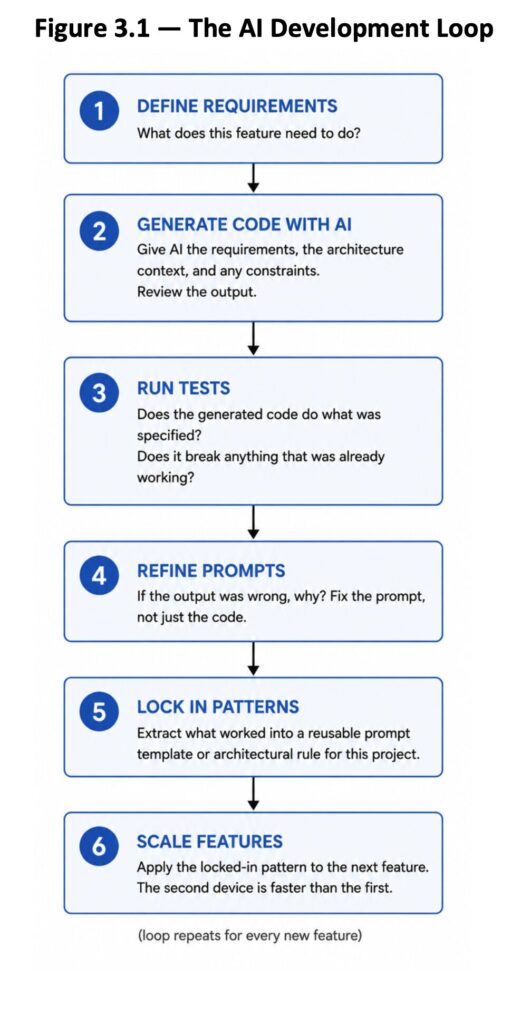
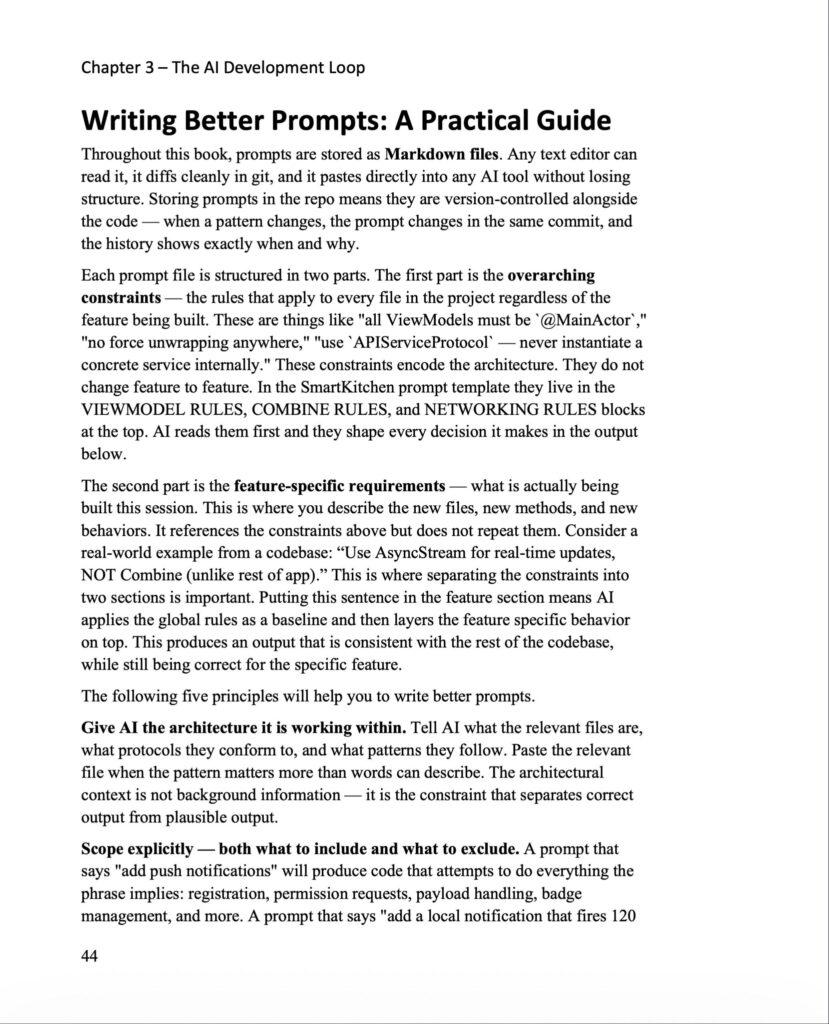
Most developers use AI the way they used to use Google or Stack Overflow — paste the error message, read the first answer that compiles, move on. That works, up to a point. It stops working when the answer that compiles is not actually correct, when the first answer uses a deprecated API, or when five individually- correct Stack Overflow answers produce a system that does not hold together. The AI Development Loop is the alternative: a repeatable six-step process that produces code you understand, can test, and can defend.
The loop runs at every scale: one function, one feature, one entire chapter’s worth of work. SmartKitchen uses it throughout this book. Every ViewModel, every view, every network layer you build in Chapters 4 through 11 passes through the same six steps. You will use the loop on every project you build after this book because the loop is not specific to SmartKitchen — it is specific to the problem of building production software with AI tools, and that problem applies everywhere.
For teachers or a self-learners
Each chapter comes with a ready-made quiz, study guide, and challenge. If you are a teacher, or a self-learner, you will love this feature. Here is a sample from the book, included at the end of chapter 3.
Checklist
☐ You can describe all six steps of the AI Development Loop
☐ You understand why requirements are scoped both positively (what to include) and negatively (what to exclude)
☐ You understand the four parts of an effective AI prompt: role context, requirements, constraints, and examples
☐ You can explain the difference between fixing the code and fixing the prompt — and why the latter matters
What You Learned
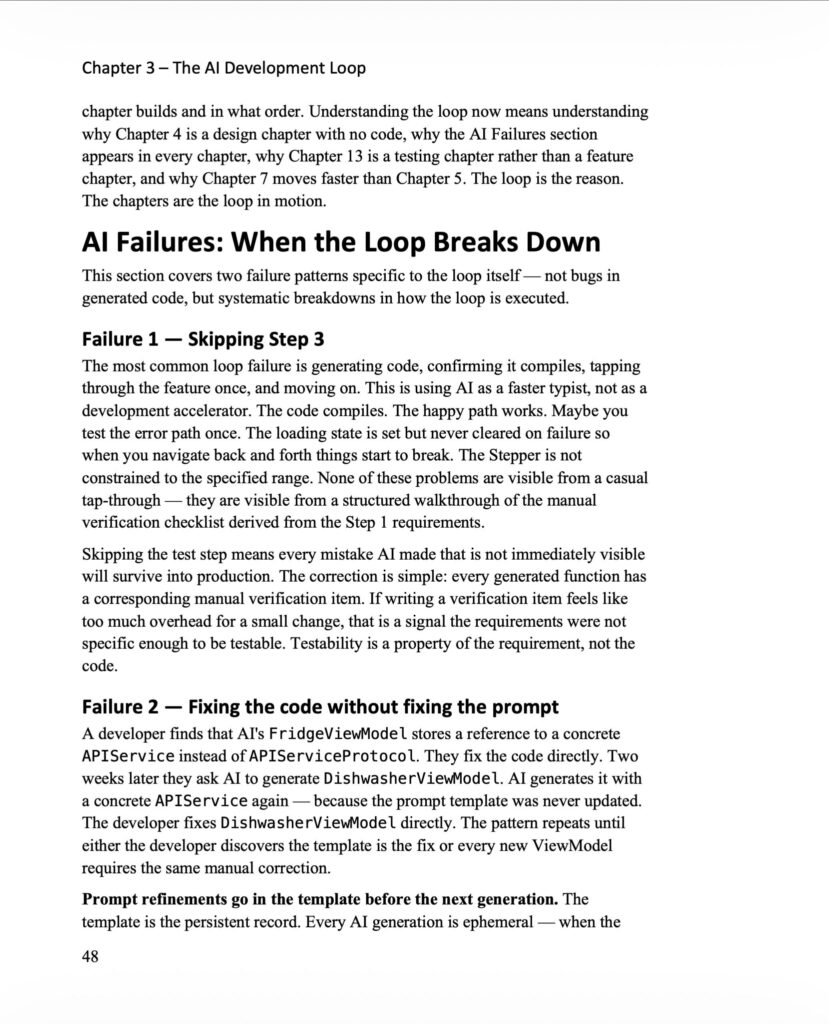
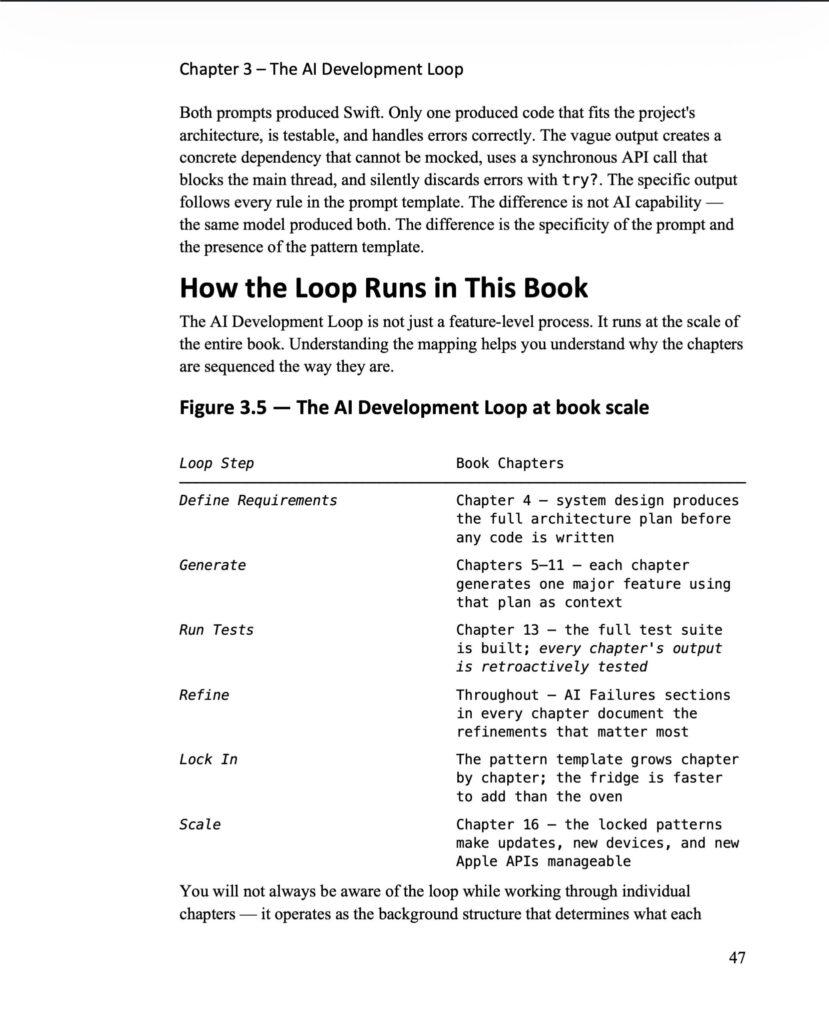
• The AI Development Loop is a six-step repeatable process: Define Requirements, Generate, Run Tests, Refine Prompts, Lock In Patterns, Scale Features
• Vague requirements produce vague code — fast. Specific requirements produce specific code — also fast. The five minutes spent writing a precise requirement saves thirty minutes of code correction.
• An effective AI prompt has four parts: role context, requirements, constraints, and an example to follow — paste the file, not a description of it
• When AI gets something wrong, fix the prompt before fixing the code — the prompt is the persistent artifact
• Locked patterns compound: the first ViewModel takes the most time; every
subsequent ViewModel is faster because the architectural decisions are already encoded in the template
• The prompt is the specification — version-control it, treat it as a first-class artifact alongside the code
Challenge
The loop has six steps, but not all features need all six. Design a “fast path” version of the loop for low-risk, high-confidence Tasks — the kind where AI reliability is high and the cost of a mistake is low (refer back to Chapter 1’s trust matrix). Which steps can be abbreviated or combined for a boilerplate Codable conformance? Which steps are non-negotiable even for trivial Tasks? Write the fast-path loop as a modified version of Figure 3.1. Then write one sentence explaining the single condition that would cause you to abandon the fast path and return to the full loop mid-Task.
| Chapter | Topic |
| 1-3 | Setup, Architecture, AI Workflow |
| 4-7 | Viewmodels, State management |
| 8-11 | Networking, Authentication, Logging |
| 12-14 | Unit Testing, Security, UX Design |
| 15-16 | App Store, Updating Apps |
What’s Inside
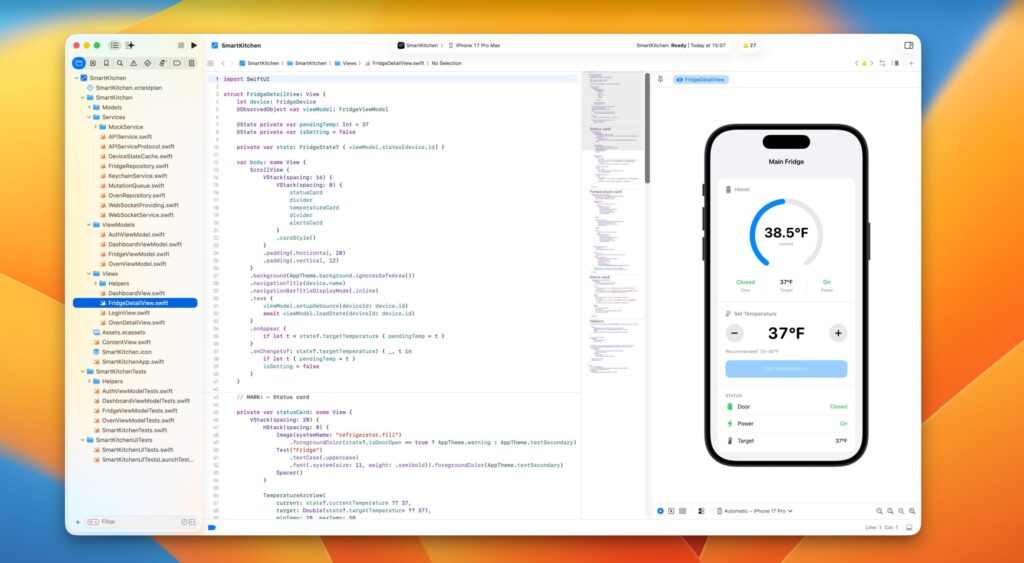
Every chapter builds on the last, walking you through the construction of a production iOS app from scratch, using AI at every step. We provide the full working prompt for every chapter and show you exactly how it was created, so you can apply the same thinking to any project of your own.
This book goes beyond iOS. Whether you’re a developer, designer, product manager, or anyone who works with AI daily, the skills we teach you in this book are the same: knowing how to direct AI precisely enough to get something real and useful out of it. The patterns for writing clear prompts, catching AI mistakes, and knowing when you can and can’t trust the output.
Prefer to Read Online
A fully interactive PDF version is on its way. You can search through topics, copy code and prompts directly into your project.
Reader Insights and Praise
Discover heartfelt reviews from readers who have transformed their iOS development journey with our AI programming guide.

This book truly opened my eyes to integrating AI seamlessly into our apps — an invaluable resource for any iOS developer.
The clear explanations and practical examples will make using this textbook a joy for my class.